Catalyzing transformative impact through mission-driven collaboration

Shared data. Shared platforms. Shared capital models.
One backbone — so organizations stop duplicating and start compounding.
Credit card mockup
What we do

We empower mission-aligned collaboration at scale

Collective Impact Labs builds and operates shared infrastructure for mission-driven ecosystems.

Nonprofits, social enterprises, funders, and innovators share common goals, but they’ve never had a common operating layer.

We’re building the shared data systems, coordination platforms, and capital models that let organizations collaborate at scale instead of duplicating in silos.
Challenge #1

Fragmented ecosystems

Organizations, contributors, and funders often operate in silos, duplicating efforts, missing opportunities to coordinate, and struggling to find the right partners or resources at the right time.
our response #1

Healthy Ecosystem Models

We develop shared frameworks and operating models that help ecosystems align around common goals, clarify roles, build trust, and sustain collaboration over time - without centralized control.
Challenge #2

Insufficient visibility and alignment

Promising initiatives remain under-resourced because funders, partners, and contributors lack clear ways to discover opportunities, understand priorities, or align resources around shared outcomes.
our response #2

Participation Pathways and Collaboration Tools

We create clear pathways and corresponding tools for people and organizations to discover opportunities, onboard, contribute, and collaborate — lowering friction and expanding participation across the ecosystem.
Challenge #3

Disjointed infrastructure and coordination gaps

Even when missions align, shared infrastructure and common operating frameworks are often missing — making coordination slow, fragile, and difficult to scale across organizations and contexts.
our response #3

Shared Infrastructure

We co-design and implement the foundational systems (governance, coordination, data, resource-allocation frameworks) that enable organizations, contributors, and funders to collaborate effectively.

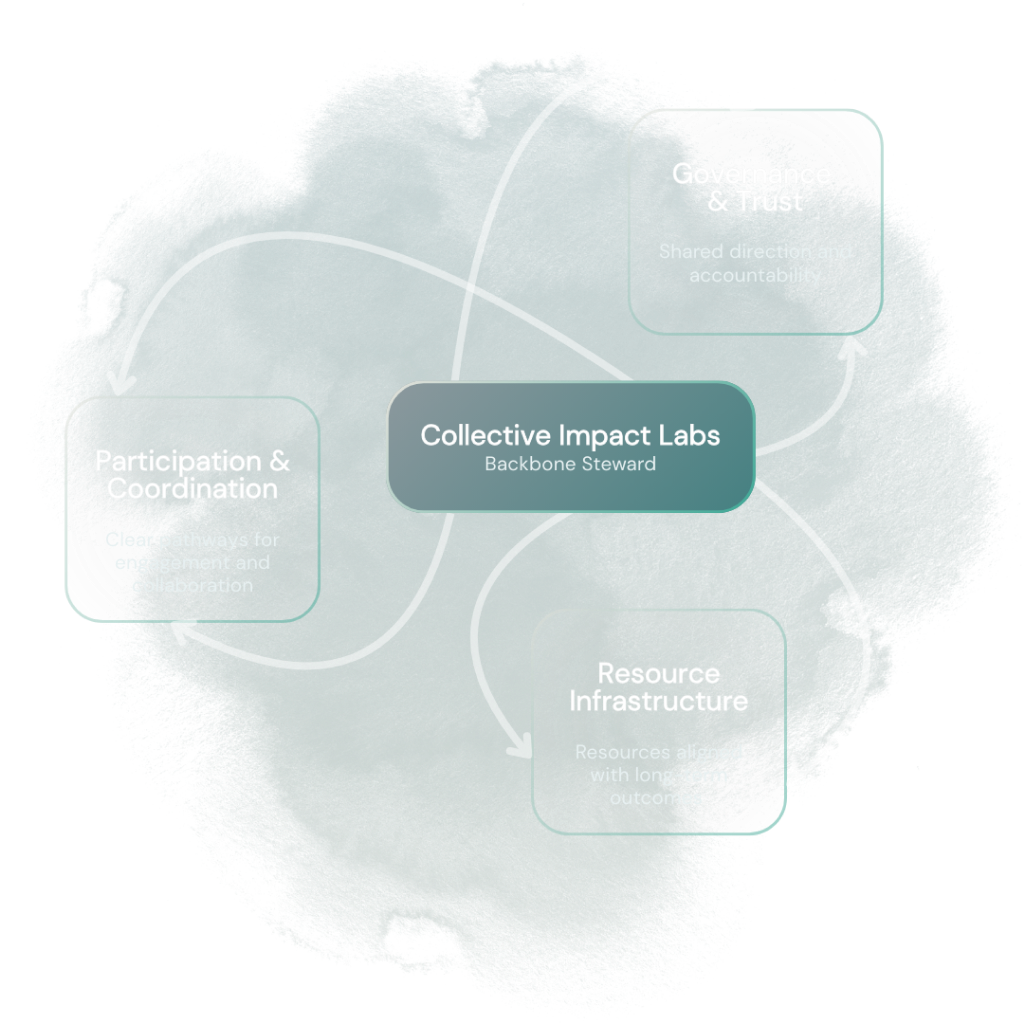
A Backbone Model for Ecosystem Collaboration

Collective Impact Labs supports mission-aligned ecosystems by stewarding shared infrastructure across governance, coordination, and capital — enabling collaboration that is resilient, scalable, and adaptable.
CIL Diagram

Backbone stewardship in practice

We are turning theory into practice through a highly-focused core initiative: Global.Church Alliance (GCA)

GCA is the first applied context for CIL’s backbone model - a network serving the global Christian ecosystem by uniting ministries, church networks, innovators, and funders around shared objectives. GCA partners are leading interoperability and collaboration initiatives, with CIL providing backbone support through convening, facilitation, and coordination infrastructure. Separately, CIL is developing resource infrastructure models that are anticipated to integrate into alliance contexts as they mature.

GCA and CIL are co-developing three models of shared infrastructure to validate, stress-test, and refine backbone capabilities - not to create parallel centers of gravity.

Interoperability: Unlocking Silos
>
Shared Semantic Ontology & Common Frameworks

Two complementary initiatives establishing shared language, definitions, and coordination frameworks across mission-aligned organizations. By creating common ontology and measurement standards, CIL enables organizations to align, coordinate, and build trust — laying the foundation for interoperability without centralized control.

Innovation: Participation & Coordination
>
Mission Collective: Ecosystem Health Infrastructure

A purpose-built platform enabling mission-aligned ecosystems to connect, coordinate, and build trust. Searchable directories, ecosystem mapping, trust-based attestations, and secure messaging.

Resource Infrastructure
>
Ravah: Mission-Aligned Capital Model

Resource infrastructure designed to test financing models that reinforce long-term ecosystem health.

Ravah transforms one-time donations into self-sustaining, capital-recycling engines through revenue-sharing with local micro-enterprises, demonstrating how capital can strengthen trust and accountability.

Learn more

What We’re Building

We're building the connective tissue that mission-aligned ecosystems need to collaborate at scale

CIL doesn’t just talk about coordination — we build the infrastructure that makes it possible. Here’s what’s live, what’s in development, and what’s coming next.

The Knowledge Graph

The first shared data layer for the impact ecosystem

Most mission-driven organizations can’t see past their own walls. They don’t know who else is working on the same problem, in the same region, with the same population — and neither do the funders trying to support them. The Knowledge Graph changes that by connecting organizational data across the ecosystem into a single, queryable layer — without any single organization owning or controlling the data.Built on semantic web standards (OWL/RDF), the Knowledge Graph creates machine-readable connections between organizations, initiatives, people, and resources. It’s the difference between a spreadsheet of contacts and a living map of how an entire sector fits together.

What’s Been Built

 Multiple independent data systems semantically aligned into a shared layer — each organization retains its own methodology, but data can now flow and be queried across boundaries
 Formal ontology making definitional differences between systems explicit and navigable, rather than forcing artificial harmonization
 A shared engagement measurement framework co-developed across leading partner organizations, enabling multidimensional tracking of progress rather than flat, single-metric snapshots
 Open standards throughout (RDF, OWL, SPARQL) — no vendor lock-in, no single owner
 Shared vocabulary enabling data to flow across previously siloed systems while preserving each organization’s integrity

Who It Serves

Any organization, funder, or researcher who needs to understand the landscape of social impact work — where gaps exist, where duplication is happening, and where resources should flow.

What’s Next

Phase 2: integrating field-level activity data from partner organizations, enabling ground-truth data to inform ecosystem-wide assessments in closer to real time.

Mission Collective — The Coordination Platform

Where mission-driven organizations connect, discover, and collaborate.

Mission Collective is the operating system for ecosystem coordination. It gives nonprofits, social enterprises, funders, and innovators the connective tissue they’ve never had — a shared platform where they can find each other, see where they fit in the larger ecosystem, build trust, and coordinate action.

It’s not a social network. It’s not a CRM. It’s coordination infrastructure: searchable directories, interactive ecosystem mapping, trust-based attestations, community exchange, secure messaging, and steward tools for ecosystem health.

Core Capabilities

 Searchable Directories — Find organizations, contributors, and initiatives by mission focus, geography, capabilities, and needs
 Ecosystem Mapping — Interactive visualization of how organizations relate and where coordination gaps exist
 Trust-Based Attestations — Organizations vouch for each other based on real collaboration history, building verifiable trust without centralized certification
 Secure Messaging — Privacy-first communication for trust-sensitive coordination across organizations and cultural contexts
 Steward Tools — Health metrics and coordination dashboards for ecosystem leaders

Design Principle

Signals inform. Algorithms advise. Humans decide.

Who It Serves

Currently piloting with 40-60 organizations. Designed to be deployable across any mission-aligned ecosystem.

Ravah Capital Pool — Regenerative Capital

A capital model that turns one-time grants into self-sustaining, perpetual impact funding.

Traditional philanthropy works like a gas tank: donate, spend, empty, refill. The cycle exhausts funders and leaves organizations perpetually fundraising instead of doing their core work. Ravah works differently — it transforms philanthropic capital into revenue-sharing partnerships with local enterprises, so capital recycles and compounds rather than depleting. It’s regenerative capital infrastructure: designed so that every dollar given today funds impact work not just this year, but in perpetuity.

How It Works

 Phase 1 (Principal Return): 70% reinvested in the pool, 20% distributed as impact grants, 10% covers operations
 Phase 2 (Profit Phase): 60% distributed as grants, 20% reinvested, 20% operations
 Capital is asset-backed for transparency and accountability
 Revenue-sharing with local micro-enterprises builds economic resilience at the community level

Scale

Primary pilot: $60M over 5 years with a major international partner, projecting $278M in annual perpetual grants at maturity.
First deployment: Mozambique.

Who It Serves

Funders who want their capital to compound rather than deplete. Communities that need sustainable economic models rather than dependency cycles.

Our First Applied Backbone

CIL’s coordination infrastructure in action, serving a global alliance of mission-aligned organizations.

CIL’s first applied backbone serves the Global.Church Alliance — a growing coalition uniting churches, ministries, missions organizations, faith-driven nonprofit and for-profit organizations, funders, and individual contributors around the shared objective of advancing global mission through collaboration rather than competition. CIL is developing the alliance’s coordination backbone: the shared governance, facilitation infrastructure, and technical systems that make large-scale multi-stakeholder collaboration actually work.

This is where all of CIL’s shared infrastructure comes together in practice. A shared data layer connects organizational data across the alliance. A coordination platform gives members the tools to find each other, build trust, and act together. A consent-aware decision-making framework enables collective action without centralized control. And a regenerative capital infrastructure (in development) will turn one-time contributions into perpetual impact funding. Together, they demonstrate that dozens of autonomous organizations can coordinate at scale — without any single organization owning the ecosystem.

What CIL Provides

 Convening & facilitation — bringing partner organizations together around shared priorities
 Coordination infrastructure — the technical systems enabling cross-organizational collaboration
 Shared governance frameworks — structures for collective decision-making that honor organizational autonomy
 Interoperability standards — common data formats so organizations can exchange information across boundaries

Partners

The Global.Church Alliance Steering Committee includes leaders from major international networks spanning every region of the world. CIL provides backbone coordination while partner organizations lead their own interoperability and collaboration initiatives.

Descartesia — Right People, Right Roles, Right Moment

Matching mission-driven talent to impact roles across organizational boundaries.

Mission-driven organizations have a talent problem — but it’s not a shortage of talented people. It’s that the right people can’t find the right roles, because every organization recruits from its own network. A data scientist in Denver who could transform an organization in Mozambique will never hear about that opportunity. A program designer in Singapore who could accelerate a social enterprise in Dallas has no pathway to discover it.Descartesia is CIL’s human capital coordination system — helping mission-aligned organizations discover, evaluate, and share talent across the ecosystem so that skilled professionals end up where they can create the most impact.

Pilot Program

6 organizations identified for 8-12 week pilots across international development, media, education, philanthropy, and anti-trafficking sectors.

Join us to accelerate ecosystemic change

Shared governance, coordination infrastructure, and tools that make alignment easier than isolation—there are several ways to get involved.

Fund the Backbone

Every ecosystem faces the same structural challenge: coordination that depends on personal relationships doesn't scale. Your investment builds durable infrastructure — shared systems, governance, and tools — that compounds over time and serves entire networks, not just one organization. A $500,000 matching commitment is active through 2026, doubling the impact of every dollar.

Explore a Partnership

We're a backbone organization, not a competitor. We build the shared infrastructure that helps mission-aligned organizations coordinate — and we succeed when you collaborate effectively without our constant involvement. Whether it's platform adoption, co-development, data sharing, or joint pilots, we design partnerships around mutual needs.

Read the Funding Brief

For funders considering deeper engagement, our Funding Brief covers the structural problem we're solving, CIL's backbone model, our 2026 focus areas, 12-month milestones, and our path to sustainability. It's the full picture in a single document.

Read Our Whitepaper

The Collective Impact Labs whitepaper lays out the architecture — from the ecosystem fragmentation problem to our governance model, coordination frameworks, and the technology stack underpinning it all. If you want to understand the thinking behind the work, start here.

Core Team

We blend technology, strategy, and operational excellence to serve a shared purpose

Megan Miller

John Kim

Executive Director
Cameron Henrion

Cameron Henrion

Chief Business Officer
Emily Carminati

Emily Carminati

Operations Lead
Megan Miller

Yan Chen

Designer
Megan Miller

Aaron Reuben

Executive Operations
Megan Miller

Ayooluniyi Zoe Ojeniyi

Operations Assistant
contributors

Our work is fueled by an expert network committed to sustainable social transformation

Cameron Henrion

Co-founder and Chief Business Officer

Cameron Henrion is a strategist, operator, and mission-driven builder with over 15 years of experience spanning military service, nonprofit leadership, and financial advisory. After graduating from the U.S. Air Force Academy and earning a master’s in theology, he led sustainability efforts in anti-trafficking initiatives and ran a fractional CFO firm serving businesses and nonprofits alike. Based in Detroit with his wife and four children, Cameron co-founded Collective Impact Labs to equip purpose-driven leaders with the systems and support they need to thrive.

John Kim

Co-founder and Executive Director

John F. Kim is a technologist, ecosystem builder, and impact strategist working at the intersection of faith, technology, and social good. As co-founder of Collective Impact Labs, he helps lead strategic efforts to explore and design future-ready solutions that unify vision with technology, research, and community-rooted practice. John’s work spans domains including decentralized systems, data governance, ecosystem design, and social enterprise.

Emily Carminati

Adminstrator

Emily Carminati is a creative strategist and communicator with nearly 30 years of experience across media, content, and operations. As Operations Lead at Collective Impact Labs, she brings clarity to complexity and helps translate big ideas into communication that connects. Emily is drawn to mission-driven work because she believes how a story is told shapes whether people show up for it, and she brings curiosity, kindness, and calm to every team she joins.

Yan Chen

Designer

Yan Chen is an interdisciplinary designer with over 10 years of experience building products and services across Asia, Europe, and North America. As a Designer at Collective Impact Labs, she combines strategy, project management, and end-to-end design to distill complex challenges into clear, human-centered interactions. Yan specializes in building unified multi-platform ecosystems for diverse stakeholders and facilitating design thinking to drive innovation.

Ayooluniyi Zoe Ojeniyi

Operations Assistant

Ayooluniyi Zoe Ojeniyi is a multidisciplinary professional whose work spans creativity, social impact, and organizational support. She is deeply interested in how thoughtful structure, creative thinking, and values can be combined to design better systems, experiences, and futures for people and places.

She leads initiatives that support leadership development, creative expression, and purpose formation, with a background that cuts across nonprofit programs, community work, and creative strategy. Known for her clarity, initiative, and systems-minded approach, Ayo brings both imagination and operational strength to the teams and ecosystems she serves.

Her life’s work is grounded in exploring how creativity and structure can work together to help individuals and communities thrive.

Aaron Reuben

Executive Operations

Aaron Reuben is a versatile operations and research professional bridging the worlds of theology, social innovation, and investment. He has served as an Operations Administrator at Trinity West Church and an independent consultant. He holds a Master's from the London School of Economics and an Advanced M.Div. from The Southern Baptist Theological Seminary. Aaron’s diverse background ranges from developing blockchain curricula at Access Ventures to consulting for social enterprises in South Africa, all underpinned by a commitment to translating complex concepts into actionable strategies for mission-driven organizations.